ROSSLYN CHAPEL, Roslin, Scotland
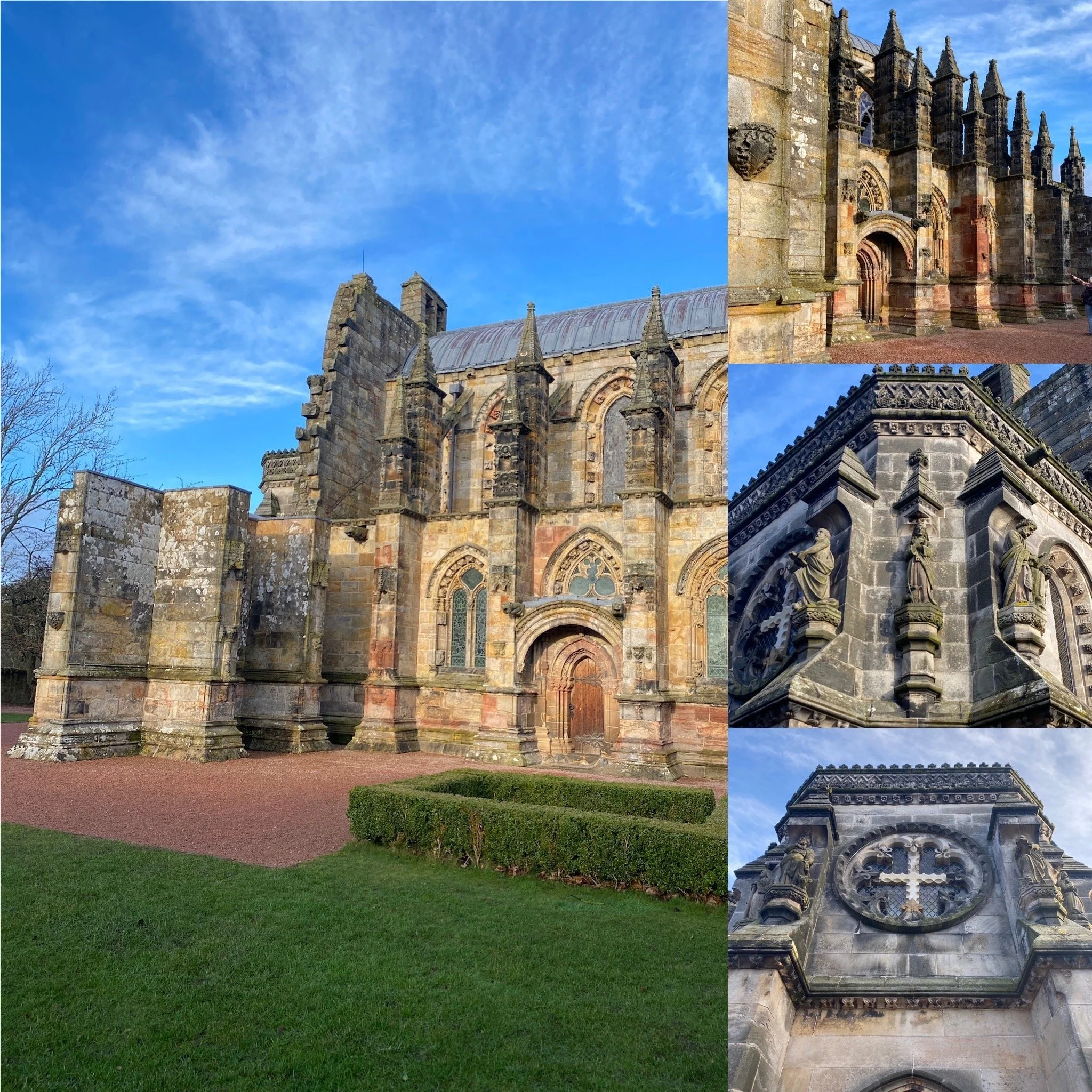
Between Christmas and New Year I spent 3 nights hanging out with my brother in Edinburgh - my first time in the city, though not his. I loved it :) My intention was to report back on my experience of Arthur’s Seat, but given we climbed the ancient volcano’s 251 metres (above sea level) in Storm Gerrit - and was nearly blown off my feet - I found it difficult to tune into the energies of it. I did, between the gusts, pick up some crossing energy lines at the top, but decided to leave a report on Arthur’s Seat to another day. The energy and atmosphere of it set me up beautifully though for our trip the next day, 7 miles south of Edinburgh to Roslin Glen and the infamous Rosslyn Chapel (you may remember it as a location in the Dan Brown film ‘The Da Vinci Code’). Now, I could focus…
The chapel is beautiful. Tastefully ornate, mesmerising and quite perfect in its own way. Walking the exterior there is so much to see…and I am also drawn inside - it is as beautiful outside, as in…balanced, upon itself. The history lingers in the air of the well-kept gardens and I notice an energetic light surrounding and beaming on and from the chapel’s exterior. I recognise that it is surrounded by angels and angelic realms. Its aura contains more than this though. ‘Hidden monastery’ and ‘something underground’ are words which come to me. Something is going on here.
Entering through a definitive entrance (always a delight to feel a threshold and the quickening of heart this can bring) and the energetic - and emotional, I want to say - warmth opens my aura. It’s beautiful…complete with stone motifs and engravings in every corner and possible place. (Photography is not permitted, or I would be including these images). Founded in 1446, the chapel took over 40 years to build, still incomplete when its founder, Sir William St Clair, died in 1484. The array of stone symbols within the chapel portray a vast range of subjects, from Biblical tales to Pagan symbolism, with Rosslyn renowned for having over 100 carvings of the Green Man. The chapel displays its gems well with useful descriptions: ‘…also known as Foliate Heads, Green Men have been around since pagan times, often appearing in Christian Church architecture, believing to represent the unity between humankind and nature and as a symbol of fertility: the male counterpart to Mother Earth.’ The carvings of the Seven Deadly Sins and Seven Acts of Mercy are reminders of the inherent timelessness of the chapel, but the carving which amused (and reassured) me the most was the King Darius Lintel ‘Forte est vinu. Fortior est rex. Fortiores sunt mulieres: sup om vincit veritas’, which translates as: ‘Wine is strong. The king is stronger. Women are stronger still: but truth conquers all.’
Motifs of flowers blanket the ceiling: carved daisies, lilies, roses, simple flowers and stars show the chapel’s theme of nature whilst also carrying layers of meaning. Lillies and roses are identified with the Virgin Mary apparently, and it’s the feminine energy of the chapel which grabs my attention, contrasted with the more male energies of the Crypt. In the Lady Chapel, amongst a feeling of ‘women are the link to the Earth’ I notice the smell of roses. Perhaps, someone’s perfume, another visitor…but I’m not so sure. (I have smelt it once since, whilst alone and with no reason for the scent of roses. Both times, the scent grabbed my attention and sense of inquiry).
Moving down into the Crypt (where most of the filming took place in The Da Vinci Code) and the energy shifts. ‘A misuse of power’ comes to mind. One after another, scenes present themselves in my mind: spilt red wine and a table…kneeling men, robed, heads covered and bowed before the altar. Benedictine monks…A burial chamber…the darkness hid more than secrets…the visiting of the newly deceased: an opportunity to exchange vital knowledge, to pass notes and whisper information. A transfer of activity…an ‘information chamber’. The atmosphere is visceral and telling, and still...mysterious. But whatever happened in this room: ‘the crypt misses the point’, I sense.
Leaving the chapel, my sense is it continues to give healing of some sort - a ley-line between realms - and this intention secures its place within a grander reality. It is a visit which has remained with me…a story still unfolding.
Love
Delilah
Visited: 29.12.23
PS. Rosslyn Chapel (and nearby Rosslyn Castle, not open to the public) sit within the landscape of Roslin Glen Country Park, which is also well worth visiting. From the late 18th century onwards, many writers and artists, such as William Wordsworth and Robert Burns, reputedly visited the glen for inspiration. We walked down into the valley, to the River North Esk - an area of magical influences and alive with history. We roamed through the abandoned Gunpowder Mill, past rock faces carved 3000 years ago during the Bronze Age with ‘cup and ring marks’ and through energies which resounded still, in the silence. Our favourite part was stumbling across the disused railway line and station platform (Roslin Castle Station), now the Penicuik-Dalkeith walkway which follows the Edinburgh to Peebles disused railway. I felt like I was in a scene from The Railway Children :)